There’s a moment that happens at almost every American Mahjong table.
The tiles are dealt. Everyone picks up the new National Mah Jongg League card. Eyes move quickly through the familiar sections—2468, Any Like Numbers, Consecutive Run—and then arrive at Quints.
And keep moving.
Quints can be intimidating. They require five identical tiles, which sounds impossible when there are only four natural copies of any numbered tile in the set. They depend on jokers. They often require combinations that don’t immediately jump out at you when you first look at your rack.
So many players simply decide: Quints aren’t for me.
But you may be missing out.
Quint hands can be surprisingly playable, wonderfully strategic and, when the right tiles land on your rack, downright fun. The trick is knowing when to recognize the opportunity—and when to walk away.
First, What Exactly Is a Quint?
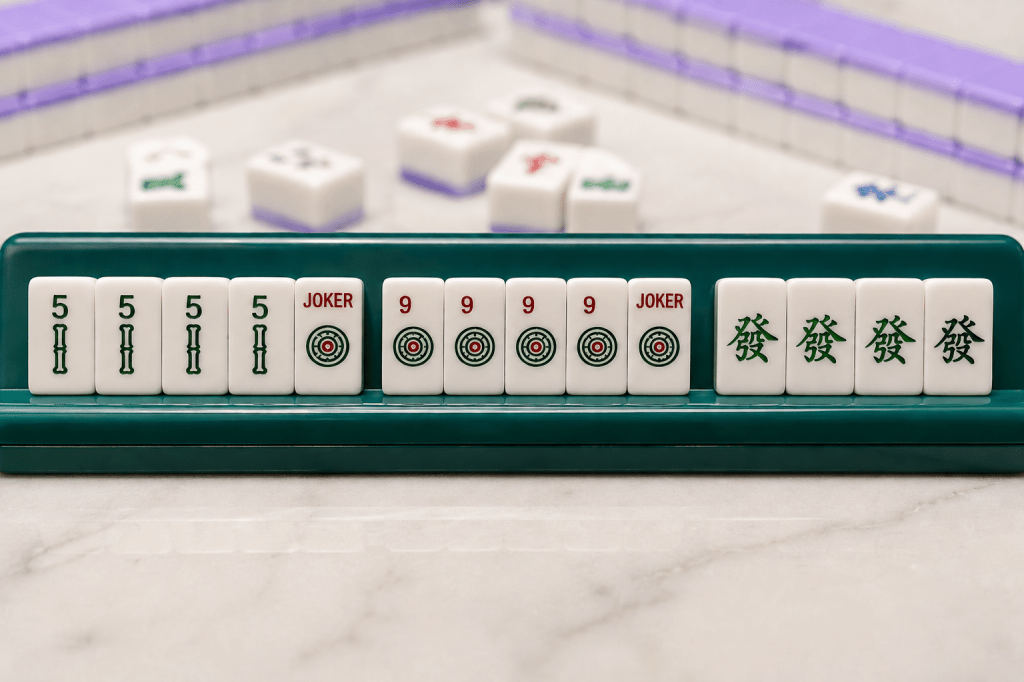
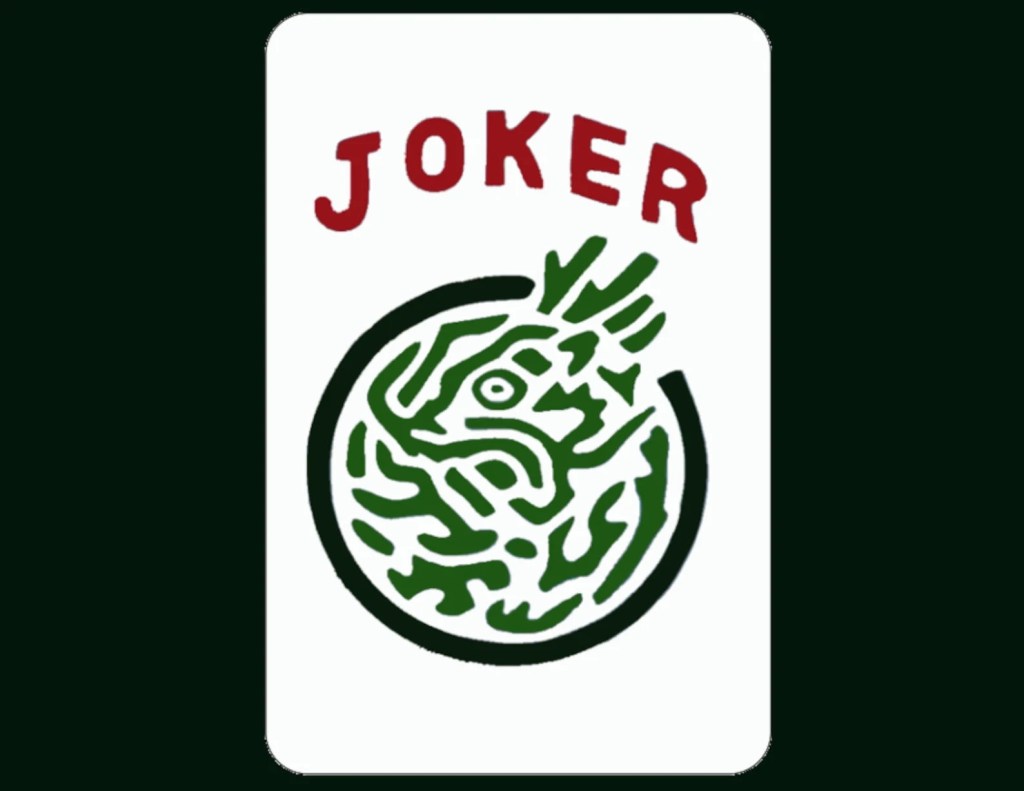
A quint is a grouping of five identical tiles. Because an American Mahjong set contains only four identical numbered tiles, a quint must include at least one joker.
For example:
5 – 5 – 5 – 5 – JOKER
That’s a quint.
And because jokers are permitted in groupings of three or more identical tiles, you can use more than one joker in the grouping if necessary.
That makes Quints one of the sections of the NMJL card where your jokers can really go to work.
Don’t Decide You’re Playing Quints Just Because You Have Jokers
You look at your initial rack.
Three jokers!
Obviously you’re playing Quints, right?
Not necessarily.
Jokers are certainly an important part of Quint hands, but they’re only part of the equation. You still need enough natural tiles to give the hand a realistic foundation.
If your rack contains three jokers but almost none of the natural tiles required by a particular Quint hand, you may be trying to force something that isn’t there.
On the other hand, suppose you’re dealt several natural tiles that work together in one of the Quint hands and a couple of jokers.
Now you should be paying attention.
The lesson is simple:
Jokers don’t make a Quint hand good. They make an already promising Quint hand better.
Look at Quints Before the Charleston
One of the easiest ways to miss a Quint opportunity is to decide what you’re playing before you’ve seriously considered that section of the card.
Perhaps you see a nice collection of consecutive numbers and immediately begin planning a Consecutive Run hand. Or you spot several even numbers and head straight for 2468.
Before you start passing tiles, take a quick look at Quints.
Does anything match?
Do you have a pair or pung of one of the important numbers?
Do you have the necessary supporting tiles?
Do you have one or more jokers?
Most importantly, do the tiles you’re considering for another hand also give you a possible path into Quints?
You don’t have to commit. You simply want to recognize the possibility before you Charleston away the tiles that made it possible.
Quints Can Be Great Pivot Hands
This is where things get interesting.
Sometimes Quints aren’t the hand you start with. They’re the hand you discover.
You may begin the game working toward another section of the card and then find yourself drawing duplicate tiles and jokers.
Suddenly that pair becomes a pung.
Then you draw the fourth natural tile.
Then a joker appears.
It’s time to look at the card again.
One of the habits that separates improving players from beginners is the willingness to revisit the card throughout the game.
Your best hand after the Charleston doesn’t necessarily remain your best hand five turns later.
The tiles are constantly giving you new information.
Listen to them.
Jokers Are Gold—but Natural Tiles Still Matter
Quint hands naturally make us think about jokers, but natural tiles are particularly important because you need them to create the foundation of your groupings.
Suppose you need a quint of 7s and you have:
7 – JOKER – JOKER
That’s certainly promising.
But you still need additional 7s.
If you already see three 7s discarded on the table, your prospects aren’t nearly as rosy.
This is why Quint players need to pay close attention to discards and exposures.
Ask yourself:
How many of my natural tiles are still available?
A joker can replace a missing tile in an eligible grouping. But it can’t make an unavailable hand magically viable.
Watch the Table
Quint hands reward players who pay attention.
Suppose you need 5s in a particular suit.
You have two.
One has been discarded.
Another player has exposed the fourth.
That’s important information.
If all four natural copies are accounted for and you don’t have enough of them to create the grouping you need, no amount of optimism will change the math.
This is especially important with Quints because you’re already relying on jokers to get beyond the four-natural-tile limit.
As soon as critical natural tiles become unavailable, reassess.
Strong Mahjong players aren’t stubborn about their hands. They’re constantly asking:
Is this hand still alive?
Joker Exchanges Can Change Everything
Here’s another reason not to overlook Quints: joker exchanges can transform your hand.
Keep watching every exposure on the table.
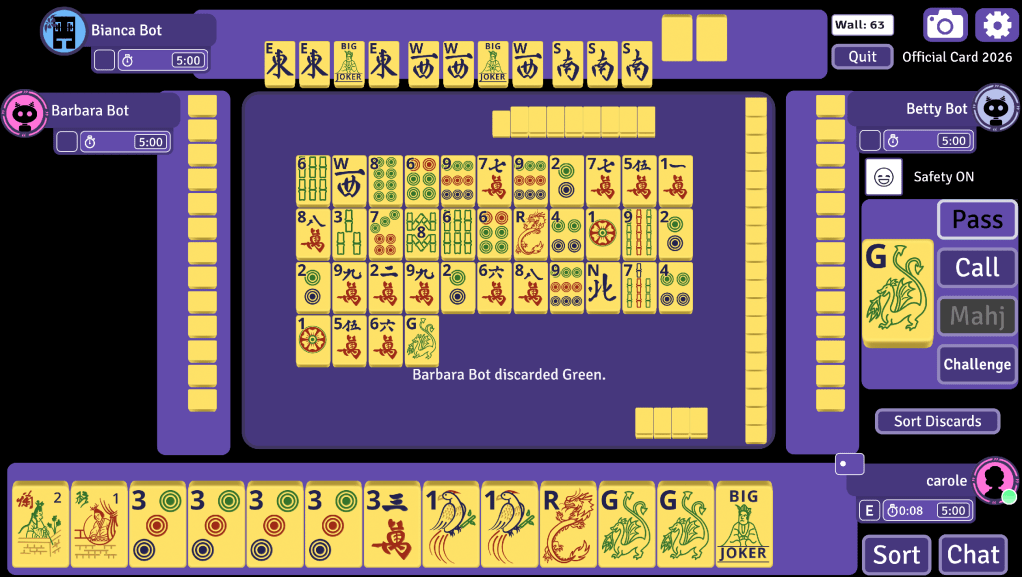
If another player exposes a grouping containing a joker and you have the natural tile represented by that joker, you may be able to exchange your natural tile for the joker when it is your turn.
And that joker may be exactly what your Quint hand needs.
This is one reason players pursuing Quints should be especially alert to exposed jokers.
You’re not just playing the tiles in your rack.
You’re playing the whole table.
Exposing a Quint Tells a Story
There is, however, a downside to making that beautiful five-tile exposure.
You’re giving away information.
A Quint exposure can significantly narrow the possible hands you might be playing. Experienced opponents may immediately start scanning the Quints section of the card and comparing your exposure with the possibilities.
Your second exposure may make your intended hand even more obvious.
That doesn’t mean you shouldn’t expose. You often need to expose to move your hand forward.
But understand the trade-off.
Every exposure says something.
And the more unusual the combination, the louder it speaks.
Don’t Fall in Love With Your Quint
This may be the hardest lesson.
You’ve got four natural tiles and a joker.
You’ve made the quint!
It’s sitting proudly on top of your rack.
It’s beautiful.
And you’re nowhere near Mahjong.
The rest of your hand isn’t coming together. The tiles you need are appearing in the discard pile. Another player may even be getting dangerously close to winning.
But you don’t want to abandon the hand because—you have a quint!
Don’t let one spectacular grouping blind you to the rest of your rack.
A completed quint is only useful if the entire hand is still viable.
Sometimes the smartest move in Mahjong is admitting that a promising hand has stopped being promising.
Quints Can Make Joker Exchanges Especially Valuable
Suppose you’ve exposed a quint using two jokers and later acquire one of the natural tiles represented by those jokers.
Depending on the situation, exchanging the natural tile for your own exposed joker can give you a joker back to use elsewhere in the hand.
That’s a wonderful feeling.
You haven’t weakened the quint. You’ve simply replaced a wild tile with its natural equivalent and recovered flexibility for another eligible grouping.
It’s another reason to keep paying attention even after you’ve completed part of your hand.
A grouping isn’t necessarily finished strategically just because it’s finished physically.
When Should You Seriously Consider Quints?
There is no magic formula, but there are several signs that should make you linger over the Quints section rather than skipping past it.
Take a closer look when:
- You have one or more jokers.
- You already have pairs or pungs of key natural tiles.
- Several of your tiles work together in the same Quint hand.
- The Charleston improves rather than weakens your possibilities.
- The natural tiles you need are still available.
- Your hand has a realistic path to completion without requiring every future draw to be miraculous.
That last point is important.
Every Mahjong hand requires some luck.
But if your strategy depends on drawing six exact tiles, three jokers and a partridge in a pear tree, you may want to reconsider.
When Should You Abandon Quints?
Just as important as knowing when to play Quints is knowing when to get out.
Consider changing direction if too many critical natural tiles have been discarded or exposed, you’re waiting for multiple jokers that are already accounted for elsewhere, or another viable hand has emerged from your draws.
And don’t wait too long.
The longer you stay committed to an impossible hand, the fewer opportunities you’ll have to pivot.
Mahjong rewards optimism.
It does not reward denial.
Quints Are Easier When You Stop Being Afraid of Them
For many players, Quints feel like the advanced section of the card—the place you’re supposed to venture only after you’ve mastered everything else.
They don’t have to be.
The basic strategy isn’t terribly different from the rest of American Mahjong:
Look for patterns. Preserve flexibility. Watch the table. Count the available tiles. Use jokers wisely. And don’t force a hand that isn’t there.
The difference is that Quints ask you to think a little more carefully about the relationship between natural tiles and jokers.
And that’s exactly what makes them so interesting.
Give Quints a Chance
The next time you pick up your NMJL card, don’t race past Quints on your way to Consecutive Run.
Stop for a moment.
Look at your rack.
Look at your jokers.
Look at your natural groupings.
There just might be a hand hiding there.
You certainly shouldn’t play Quints every game. And you shouldn’t chase a Quint hand simply because you were lucky enough to be dealt a couple of jokers.
But when the tiles are pointing you in that direction?
Don’t ignore the Quints!
Because sometimes the hand that looks a little crazy at the beginning of the game turns out to be the most satisfying Mahjong of the night.
Just one more tile…



Leave a comment