There are few sights more satisfying in American Mahjong than looking down at your rack and seeing a joker—or two. Suddenly, that tricky kong seems possible. A quint starts looking downright tempting. And the hand you weren’t sure about a few turns ago begins to come together.
But before you happily slide that joker into an exposure, consider this:
Are you using your joker too soon?
Jokers are among the most valuable—and most misunderstood—tiles in American Mahjong. Yes, they help complete hands. But their real power is flexibility. A joker sitting on your rack can potentially become many different tiles. The moment you expose it, that flexibility disappears.
Sometimes exposing a joker is exactly the right move. Other times, holding onto it for just a little longer can dramatically improve your chances of winning.
Here’s how to think more strategically about those eight wonderful wild cards.
A Joker on Your Rack Has Options
Imagine you’re working toward a hand with two kongs. You have a joker that could help complete either one.
As long as that joker remains on your rack, you don’t have to decide which kong needs it.
That matters.
You may draw the natural tile you need for one kong on your next turn. Another player may discard something that changes your strategy. Or the tiles on the table may suddenly tell you that one part of your hand is much more difficult to complete than you originally thought.
The joker gives you options.
Once you expose it as part of a pung, kong, or quint, however, you’ve made a commitment.
That’s why one of the simplest ways to improve your joker strategy is to stop thinking of jokers merely as substitutes for missing tiles.
Think of them as insurance policies.
The longer you can keep that insurance policy flexible, the more valuable it may become.
Just Because You Can Call a Tile Doesn’t Mean You Should
Here’s a familiar situation.
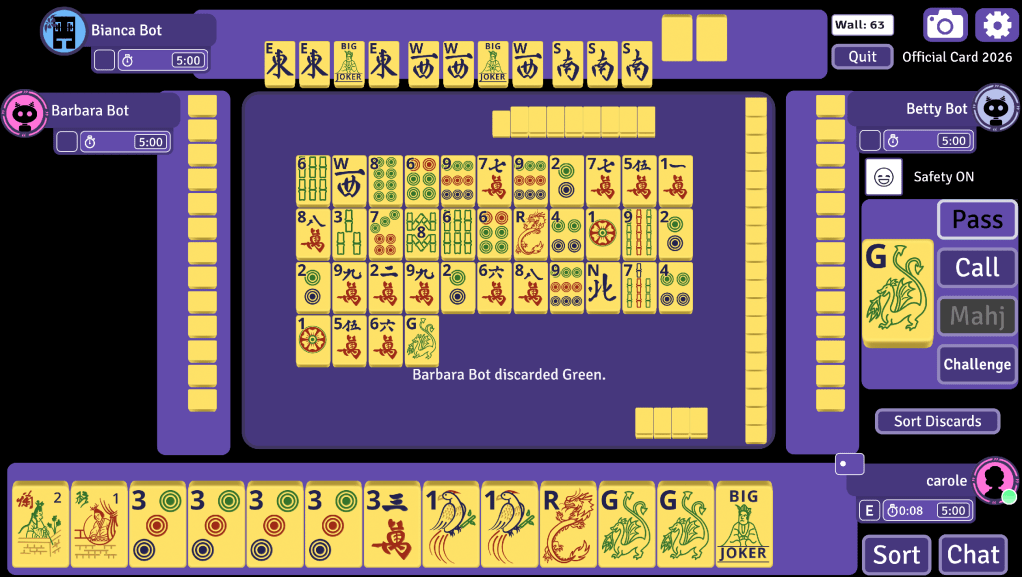
You have three matching tiles and a joker on your rack. Someone discards the fourth matching tile.
“Call!”
It’s tempting. You can make the kong, put four tiles on top of your rack, and feel like you’ve made real progress.
But have you?
Before calling, look at the rest of your hand.
Are you certain which hand you’re playing?
Do you have another possible hand that uses those same tiles differently?
Could the joker be more valuable somewhere else?
And perhaps most importantly: What are you telling the other players by exposing?
An exposure doesn’t just help your hand. It gives information to everyone at the table.
Depending on the hand you’re playing, one exposure may immediately narrow your possibilities to a handful of lines on the card. Two exposures can sometimes practically announce your hand.
If you’re early in the game and don’t need to expose yet, keeping both your tiles and your intentions concealed can be powerful.
Natural Tiles First, Jokers Later
When possible, there’s a lot to be said for building the early portions of your hand with natural tiles and saving your jokers for the difficult spots.
Suppose your hand requires two kongs.
One is already nearly complete with natural tiles. The other is still missing two tiles.
Where is your joker likely to provide the most value?
Probably in the second kong.
Using it to complete something that was likely to come together naturally may feel productive, but you may regret that decision later when you’re staring at the harder part of your hand wishing you still had that joker.
The goal isn’t simply to use jokers.
The goal is to use them where they provide the greatest advantage.
Don’t Forget About Joker Swaps
Of course, exposing a joker doesn’t necessarily mean it’s gone forever.
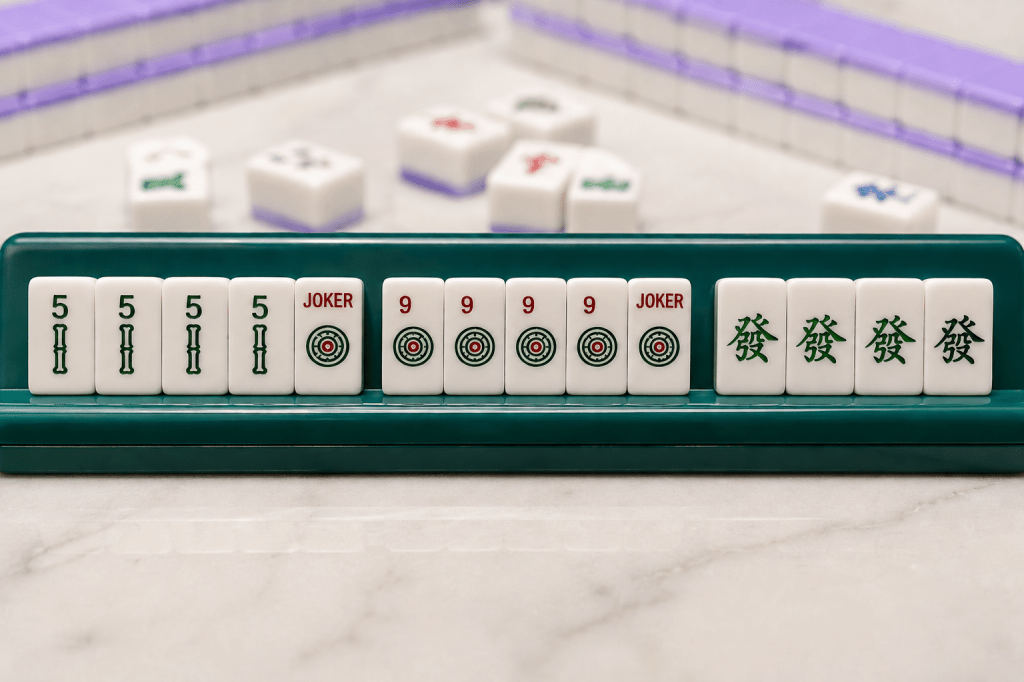
If you expose a grouping containing a joker and later draw the natural tile that the joker represents, you can exchange the natural tile for your joker on a subsequent turn when it is your turn.
And don’t forget to watch everyone else’s exposures, too.
If another player has an exposed joker and you have—or later draw—the natural tile it represents, that joker may be available for exchange when it is your turn.
This is one reason experienced players constantly scan the table.
They’re not only watching discards.
They’re watching jokers.
An exposed joker is essentially a potential resource sitting in plain sight.
Your Joker Can Also Help Someone Else
This brings us to the downside of exposing jokers too early.
An exposed joker can become a target.
Suppose you expose:
3 – 3 – 3 – JOKER
Every player at the table now knows that a natural 3 in that suit can potentially be exchanged for your joker.
You may have completed your kong—but you’ve also put a joker on the table that another player could eventually claim.
That doesn’t mean you should never expose jokers. American Mahjong would be a very different game if we all sat around protecting our jokers!
It simply means that an exposed joker has a different strategic value than a concealed one.
A joker on your rack belongs only to you.
An exposed joker may eventually help someone else.
When You Should Use the Joker
Holding jokers forever isn’t good strategy either.
A joker sitting beautifully on your rack when another player calls Mahjong isn’t particularly useful.
There comes a point when flexibility becomes less important than completing the hand.
Generally, the closer you get to Mahjong, the more aggressively you should be willing to use your jokers.
If calling a tile and using a joker leaves you one tile away from winning, that’s very different from making an unnecessary joker-heavy exposure during the Charleston’s aftermath.
Think about the game in stages.
Early game: Flexibility has tremendous value.
Middle game: Your hand should be taking shape, and strategic exposures may make sense.
Late game: Completing the hand becomes the priority.
The joker’s job changes as the game progresses.
When Jokers Become Liabilities
It’s hard to imagine looking at a joker and thinking, “I wish this were a regular tile.”
But it happens.
The most obvious example is when you’re playing a Singles and Pairs hand.
Jokers cannot be used to complete singles or pairs. Suddenly, that beautiful joker you were thrilled to draw is taking up valuable real estate on your rack.
There are other situations where jokers can become problematic, too.
Perhaps you’ve changed hands and no longer need one.
Perhaps your remaining combinations require natural tiles.
Or perhaps you’re approaching the end of the game with an extra joker that simply doesn’t have a useful place in your hand.
That’s one of the fascinating things about American Mahjong: the most valuable tile in one hand can be completely useless in another.
Be Careful What You Throw Away
So what happens when a joker really does become useless?
Eventually, you may have to discard it.
And yes, jokers can be discarded.
But remember: once a joker is discarded, it is dead. It cannot be called or picked up by another player.
That can actually make a joker an interesting defensive discard late in the game.
If the table has become dangerous and nearly every ordinary tile seems capable of giving someone Mahjong, a joker that you genuinely cannot use may be one of the safest tiles you can throw.
It feels almost sacrilegious.
But good Mahjong players know that the value of a tile depends entirely on the situation.
Don’t Let Jokers Dictate Your Hand
Another common mistake happens when players receive several jokers and immediately decide they must play a joker-heavy hand.
Three jokers?
“Quints!”
Not so fast.
Jokers can make a difficult hand easier, but they can’t manufacture the natural tiles you still need.
Before committing to a Quint hand simply because you have jokers, look carefully at the rest of your rack.
Do you actually have the foundation for the hand?
Are the natural tiles available?
Are you relying on jokers to solve too many problems?
Jokers should support a strong hand, not convince you to chase a weak one.
Watch Where the Jokers Are
There are only eight jokers in an American Mahjong set.
That means joker location matters.
As the game progresses, keep a mental inventory.
How many jokers are in your hand?
How many are exposed on other players’ racks?
Have any been discarded?
How many are still unaccounted for?
If six or seven jokers are already visible, waiting for one to rescue your hand may not be a particularly promising strategy.
On the other hand, if very few jokers have appeared late in the game, there may still be opportunities hiding in the wall.
Strong players don’t just play the tiles on their racks. They play the information on the table.
The Best Joker Strategy? Stay Flexible
There isn’t a rule that says, “Never expose a joker before turn seven,” or “Always save one joker until the end.”
Mahjong isn’t that predictable.
Instead, good joker strategy comes down to asking yourself what gives you the most options.
Before using a joker, take a moment and consider:
- Do I need to use this joker right now?
- Could I complete this grouping naturally?
- Is there a harder part of my hand that may need the joker later?
- Am I ready to reveal information about my hand?
- Could this exposure make my joker available to another player?
- Am I close enough to Mahjong that completing the grouping outweighs those risks?
Sometimes the answer will still be: Call it!
But sometimes the smartest thing you can do is leave that joker exactly where it is.
Because in American Mahjong, having the tile you need is wonderful.
Having a tile that can become almost anything you need?
That’s even better.
And sometimes the best joker is the one you haven’t used—yet.
Just one more tile…



Leave a comment